
Give the board a clearer path from budget decision to owner charges, payments, and reports.
Budgets, dues schedules, charges, payments, balances, and aging reports become board-reviewable. This page explains the workflow so a board can evaluate the operating path before a sales call.
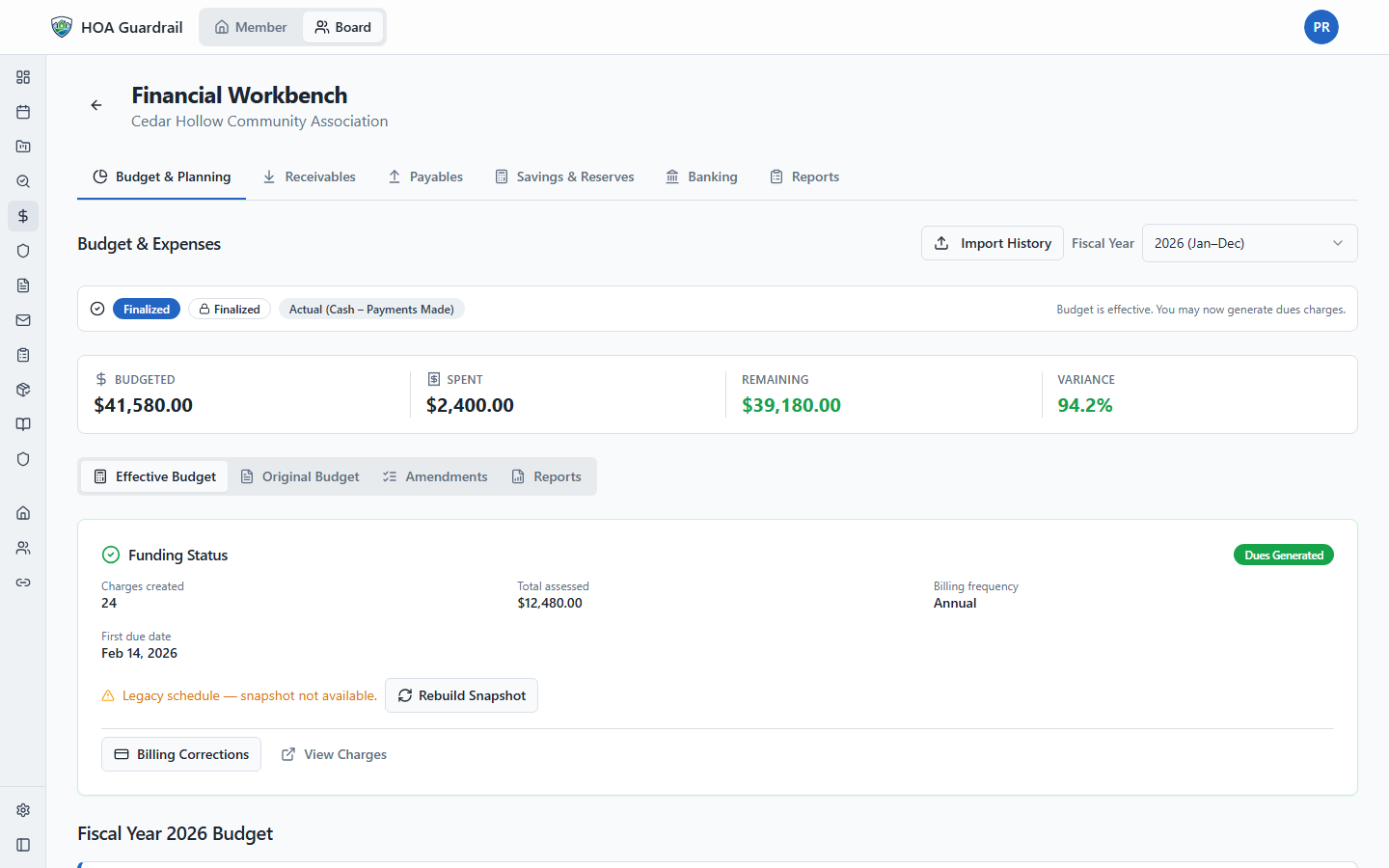
Budget planning and dues
Treasurers can review the fiscal year, budget plan, dues setup, owner charges, and funding path.
Before HOA Guardrail
What usually breaks down
The issue is rarely one missing feature. It is that the record, the decision, and the follow-up live in different places.
Budget approval, dues schedules, owner ledgers, and aging reports are handled in separate tools.
The board sees totals, but not always the trail behind them.
Treasurer transitions are painful because the working knowledge lives in spreadsheets.
Step-by-step workflow
The board can follow the path from start to finish.
This is the proof layer: what happens first, what gets attached, and where the record lands.
Publish the fiscal year and budget basis the board approved.
Generate dues schedules and owner charges from the approved setup.
Record payments and review outstanding balances by lot.
Use aging and reports to prepare board-level financial review.
Keep ledgers available for homeowner questions and treasurer handoff.
Screenshot proof
Three Cedar Hollow views that support this workflow.
Screenshots give the board concrete product evidence without needing to click through every area during the first discussion.
Budget planning and dues
Treasurers can review the fiscal year, budget plan, dues setup, owner charges, and funding path.
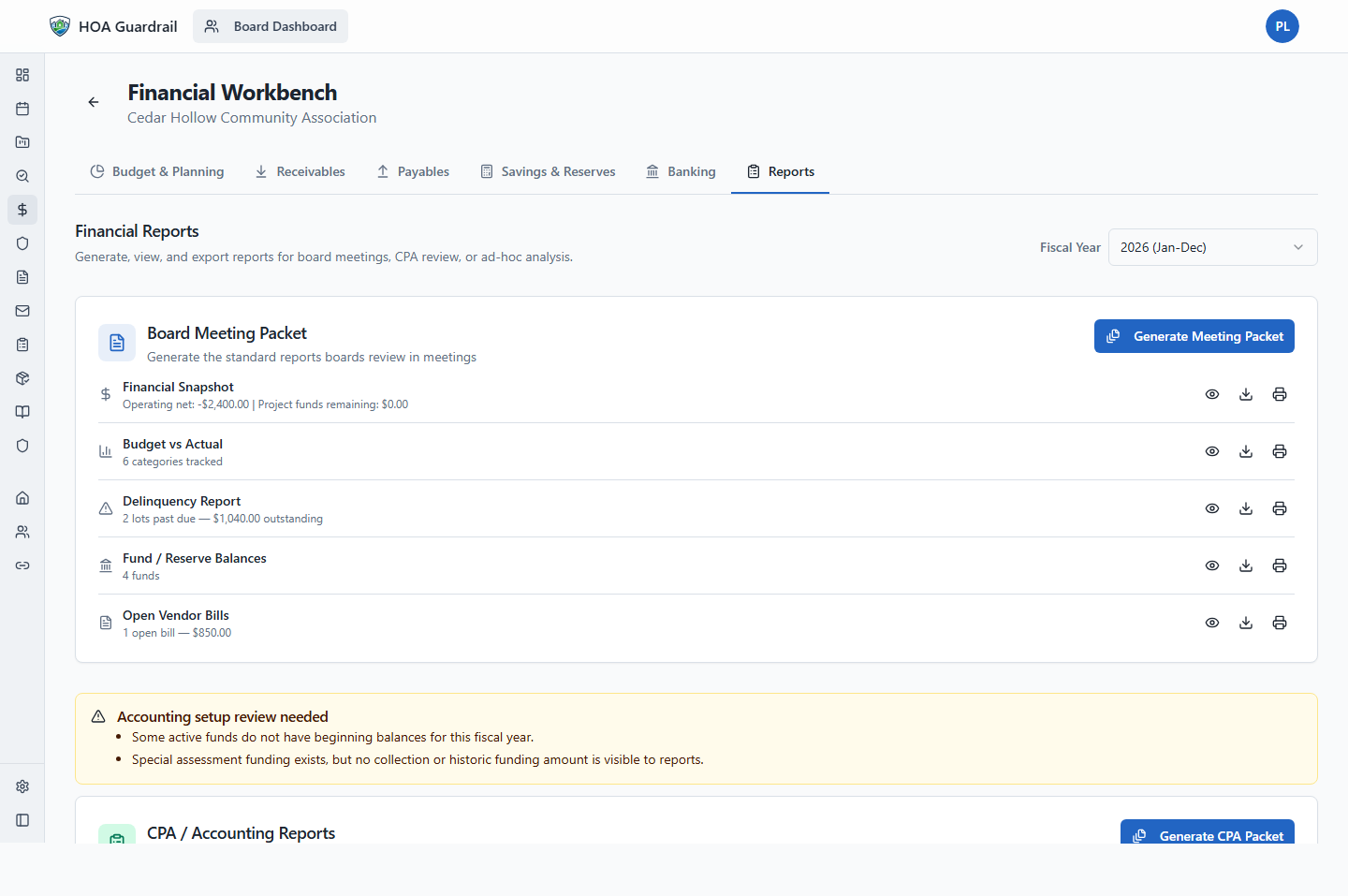
Board financial packet
Budget, receivables, fund balances, and reports are ready for review before the meeting.
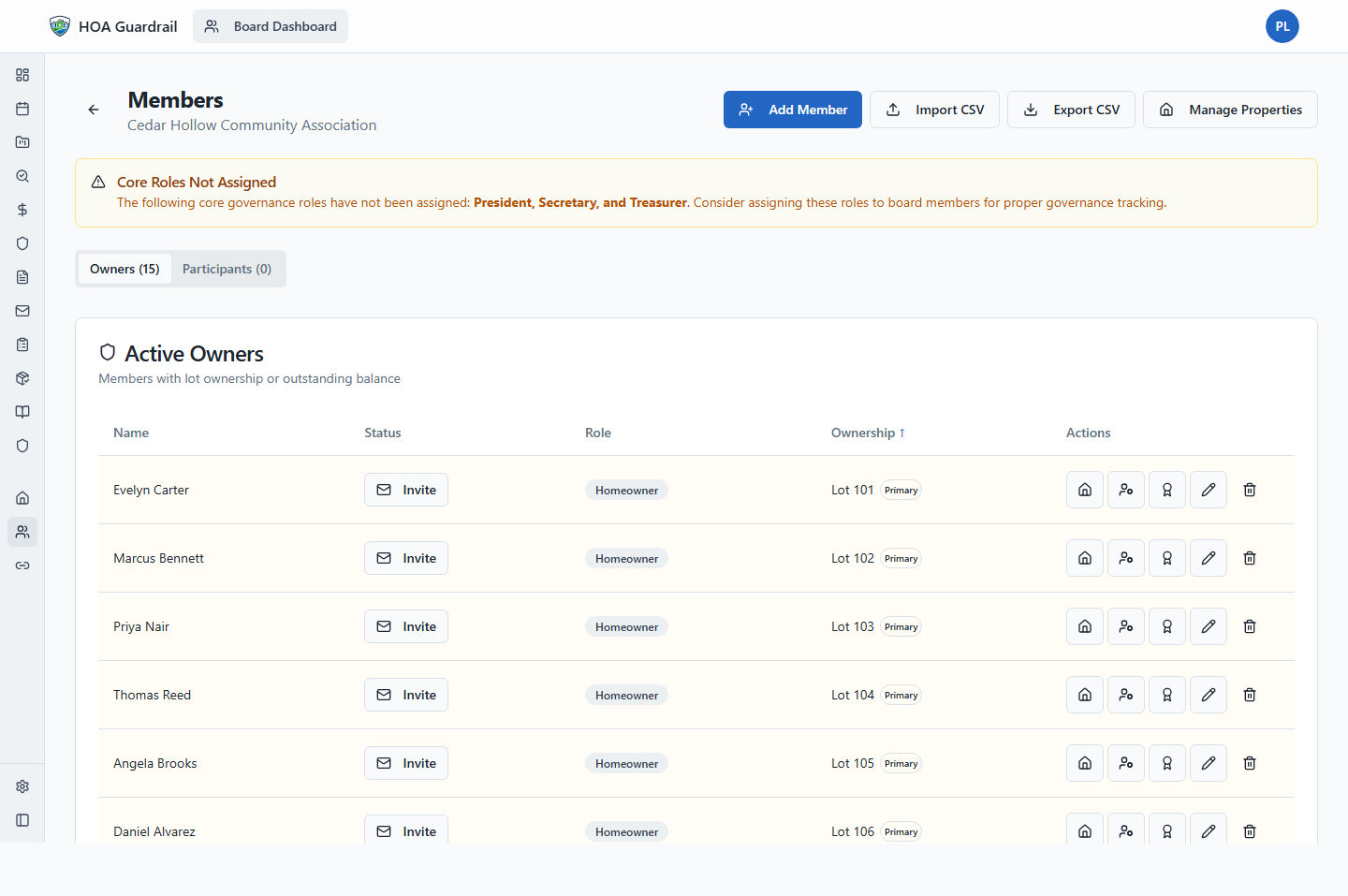
Owner and member records
Lots, owners, contact details, access, and member-facing workflows connect to the board record.
Board confidence note
What this should prove to a skeptical board member
Dues proof should make a skeptical treasurer feel that the numbers have a trail, not just a prettier dashboard.
Governance posture
Structured workflows help the board explain process and records. They do not replace legal advice.
Training path
Role-based how-to pages are planned for Phase 3. For now, use Cedar Hollow and a walkthrough to review this workflow.
Related workflows
How this connects to the rest of board operations.
A board can start with one workflow, then expand only when the next operating path is clear.
Agenda packet, notice snapshot, quorum, chair prompts, motions, votes, minutes, approval, and follow-up all stay tied to the meeting record.
Governing documents, minutes, policies, insurance, project records, contracts, and board packets stay organized without losing their workflow context.
Report, verification, notice, owner response, hearing packet, decision, and closure stay in one workflow.
Want to review dues with your board?
Use the workflow page for context, Cedar Hollow for sample proof, and a walkthrough for board-specific questions.